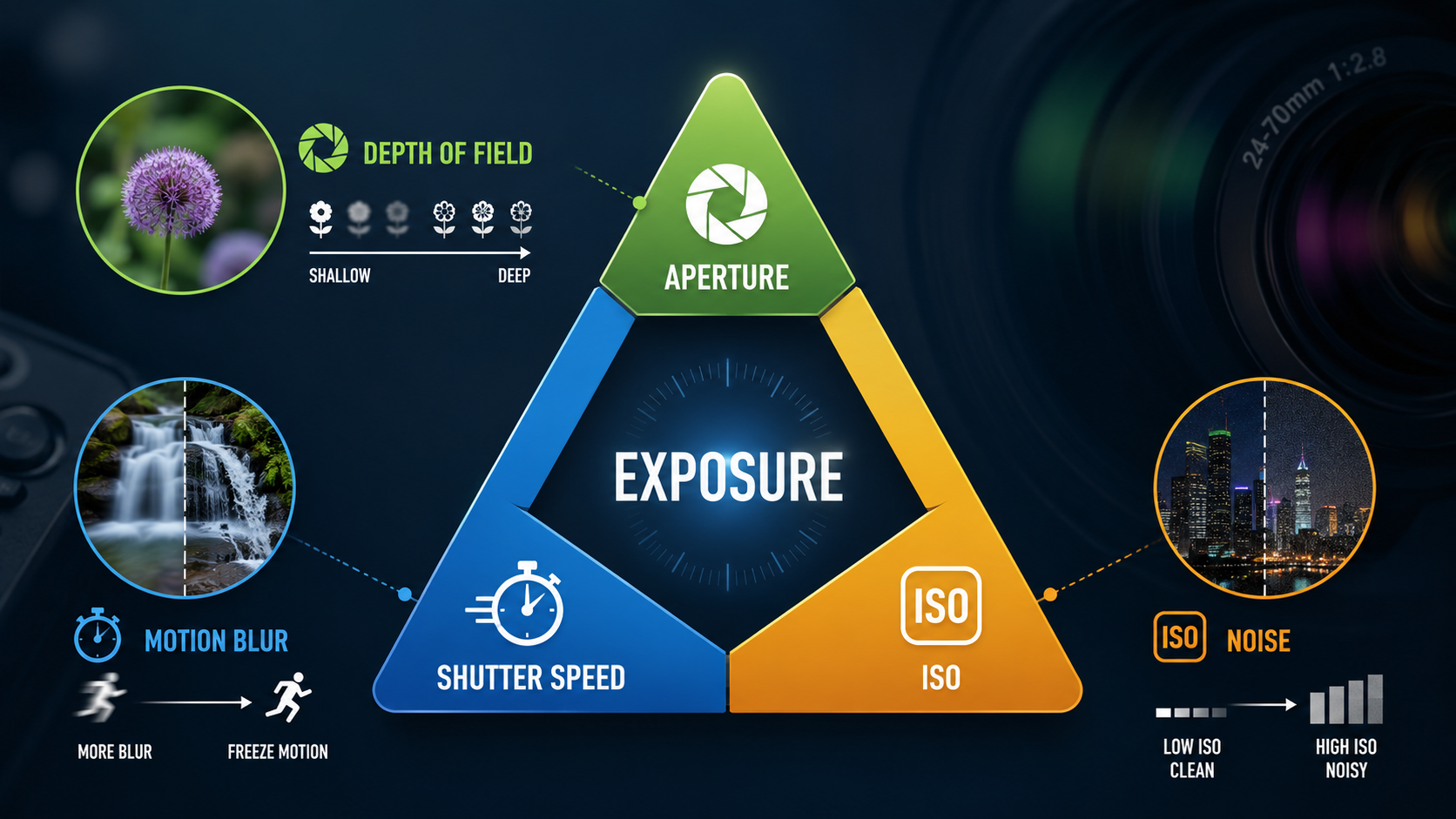
Shutter speed is the amount of time your camera records light for each photograph. A fast shutter speed records a very short moment and can freeze movement, while a slow shutter speed records light for longer and can create motion blur.
Shutter speed is one of the three main exposure controls, alongside aperture and ISO. It affects both the brightness of your photograph and the way movement appears in the image.
What does shutter speed control?
Shutter speed mainly affects three things:
- Exposure - how long light is recorded by the camera.
- Subject movement - whether motion appears frozen or blurred.
- Camera movement - whether movement of the camera causes unwanted blur.
How shutter speed is measured
Shutter speed is measured in seconds or fractions of a second. Common examples include:
- 1/1000 sec - very fast.
- 1/250 sec - fast.
- 1/60 sec - relatively slow when handheld.
- 1 second - long exposure territory.

How shutter speed affects exposure
The longer the camera records light, the more light reaches the sensor. The shorter the exposure time, the less light is recorded.
If you change from 1/30 sec to 1/15 sec, the shutter is open for twice as long, so roughly twice as much light is recorded. That is a one-stop increase in exposure.
If you change from 1/1000 sec to 1/2000 sec, the exposure time is halved, so roughly half as much light is recorded. That is a one-stop decrease.

Fast shutter speeds: how to freeze movement
Fast shutter speeds are useful when you want moving subjects to appear sharp. Sport, wildlife, children, vehicles and splashing water are all common examples.
There is no single correct shutter speed for every moving subject. The speed of the subject, its direction of travel, its distance from you and your focal length all affect how fast a shutter speed you may need.
As beginner starting points:
- 1/250 sec - useful for moderate movement.
- 1/500 sec - a good starting point for faster action.
- 1/1000 sec or faster - useful for very fast subjects when enough light is available.
These are guides rather than rules. Check your image, zoom in and adjust if the subject is still blurred.
Slow shutter speeds and motion blur
Slow shutter speeds allow movement to be recorded across the duration of the exposure. Instead of freezing motion, the camera records the changing position of the subject.
This can create intentional motion blur in moving water, traffic, people, clouds and other moving subjects.

Camera shake and handheld shutter speeds
Slow shutter speeds do not only record movement from your subject. They also record movement from the camera itself.
Nobody can hold a camera completely still. At slower shutter speeds, tiny movements of your hands can soften the photograph. This is known as camera shake.
Image stabilisation can help, but it does not freeze a moving subject. Stabilisation reduces camera movement; shutter speed still needs to be fast enough for the subject itself.
A traditional starting guideline is to use a shutter speed at least as fast as the reciprocal of your focal length. For example, with a 100mm lens, around 1/100 sec would be a starting point.
Treat that as a guide rather than a guarantee. Higher-resolution cameras, longer focal lengths, subject movement, sensor size and your own technique can all change what is practical.
Long exposures
Once your shutter speed becomes too slow to handhold reliably, a tripod or another stable support becomes useful.
Long exposures can be used to photograph:
- smooth or flowing water;
- car light trails;
- night scenes;
- moving clouds;
- star trails;
- creative intentional movement.
Many cameras offer shutter speeds down to around 30 seconds. For longer exposures, cameras often provide Bulb or Time modes.
What is Bulb mode?
Bulb mode allows the exposure to continue for longer than the camera's normal timed shutter-speed range.
Traditionally, the shutter remains open while the shutter release is held down. Many modern cameras and remote releases provide easier ways to control long exposures without touching the camera throughout the exposure.
How camera shutters work
You do not need to understand shutter construction to use shutter speed, but it helps explain some camera behaviour.
Many cameras use a focal-plane shutter with two curtains moving across the sensor. At faster shutter speeds, the second curtain begins to follow the first before the sensor has been completely uncovered, creating a travelling slit of exposure.
Modern cameras may also use an electronic shutter. A rolling electronic shutter reads the sensor progressively, while a global shutter reads the whole sensor at once.

Rolling shutters can distort very fast-moving subjects because different parts of the frame are recorded at slightly different moments.
Why subject distance affects motion blur
A subject moving quickly across the frame usually requires a faster shutter speed than one appearing to move slowly across it.
Distance matters because a nearby subject can cross a large part of your frame very quickly, while a distant subject travelling at the same real-world speed may appear to move much more slowly.
The direction of movement matters too. A subject travelling across the frame generally shows motion more clearly than one travelling directly towards or away from the camera.
Practical shutter speeds for beginners
These are useful starting points rather than fixed rules:
- Portrait of a fairly still person: around 1/125 sec or faster can be a useful starting point.
- Walking people or street photography: try around 1/250 sec.
- Children, pets or moderate action: around 1/500 sec can be a useful starting point.
- Fast sport or wildlife: try around 1/1000 sec or faster.
- Intentional motion blur: experiment with 1/30 sec, 1/15 sec or slower.
- Waterfalls and flowing water: experiment from around 1/4 sec through to several seconds, depending on the effect you want.
Light levels, aperture, ISO, focal length, stabilisation and the speed of your subject will all affect the final setting.
If changing light keeps forcing your shutter speed too low, Auto ISO and a minimum shutter speed can help the camera maintain a safer shutter speed while you concentrate on the photograph.
Shutter speed, aperture and ISO
Shutter speed works together with aperture and ISO.
If you choose a faster shutter speed to freeze movement, less light reaches the sensor. You may therefore need to use a wider aperture, a higher ISO, more light, or some combination of the three.
If you choose a slower shutter speed, more light is recorded. You may need to reduce ISO or use a smaller aperture to prevent the image becoming brighter than you want.
This is why learning the three exposure controls together is so useful: each setting affects exposure, but each also has its own creative effect.
Shutter speed explained - the key points
- Shutter speed controls how long light is recorded.
- Fast shutter speeds let in less light.
- Slow shutter speeds let in more light.
- Fast shutter speeds can freeze movement.
- Slow shutter speeds can create motion blur.
- Slow shutter speeds can also reveal camera shake.
- Each full stop doubles or halves exposure time.
- Tripods are useful for long exposures.
- Shutter speed works with aperture and ISO to control exposure.
Want to get out of Auto mode?
My beginner photography courses teach shutter speed, aperture, ISO, focusing and essential camera controls step by step. You can learn online or choose practical one-to-one photography tuition around Portsmouth.
Explore beginner photography coursesContinue the Exposure Series

Andy Hornby
Photographer, educator and workshop leader with more than twenty-five years of practical photography experience.
Learn with Andy