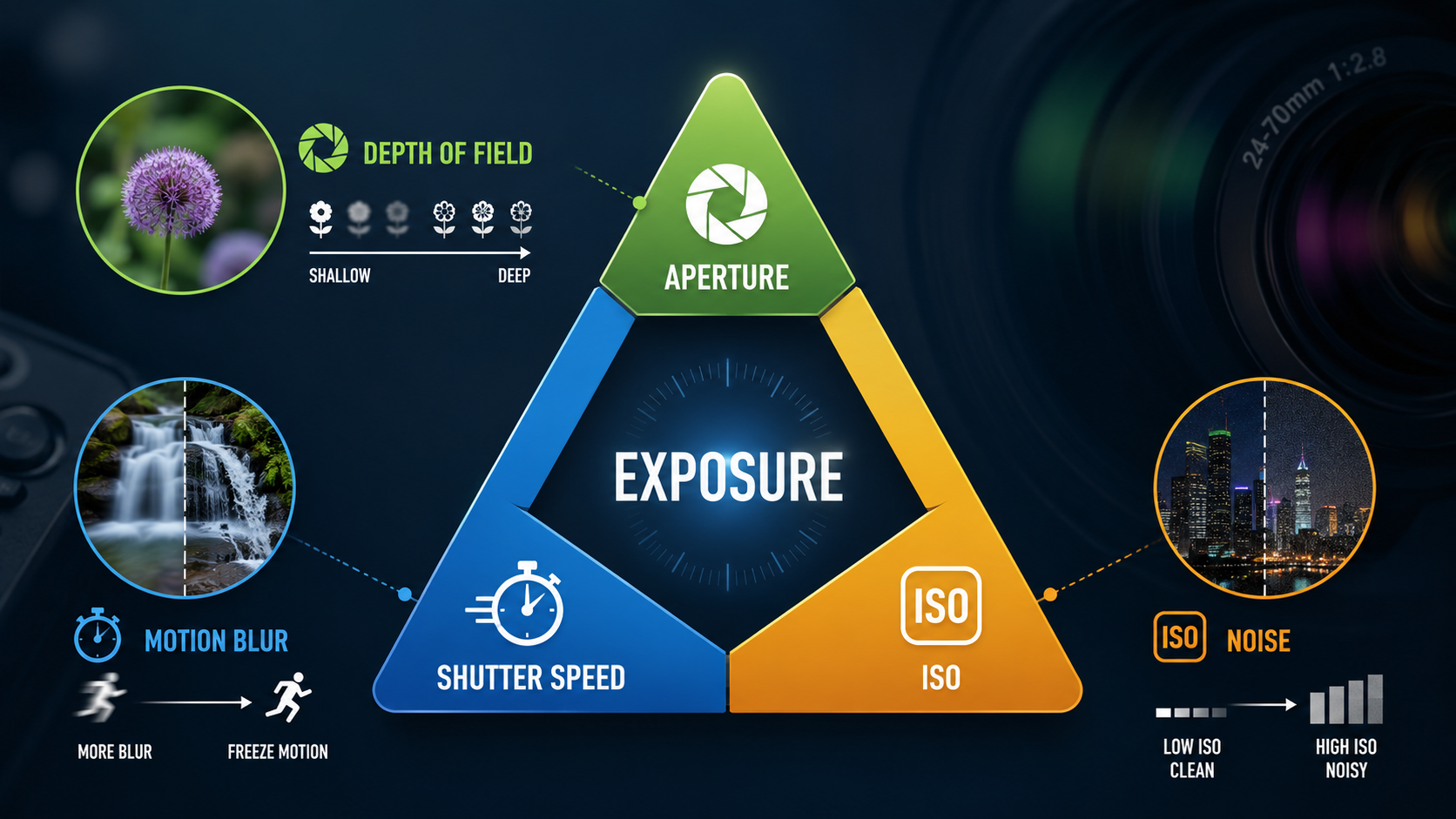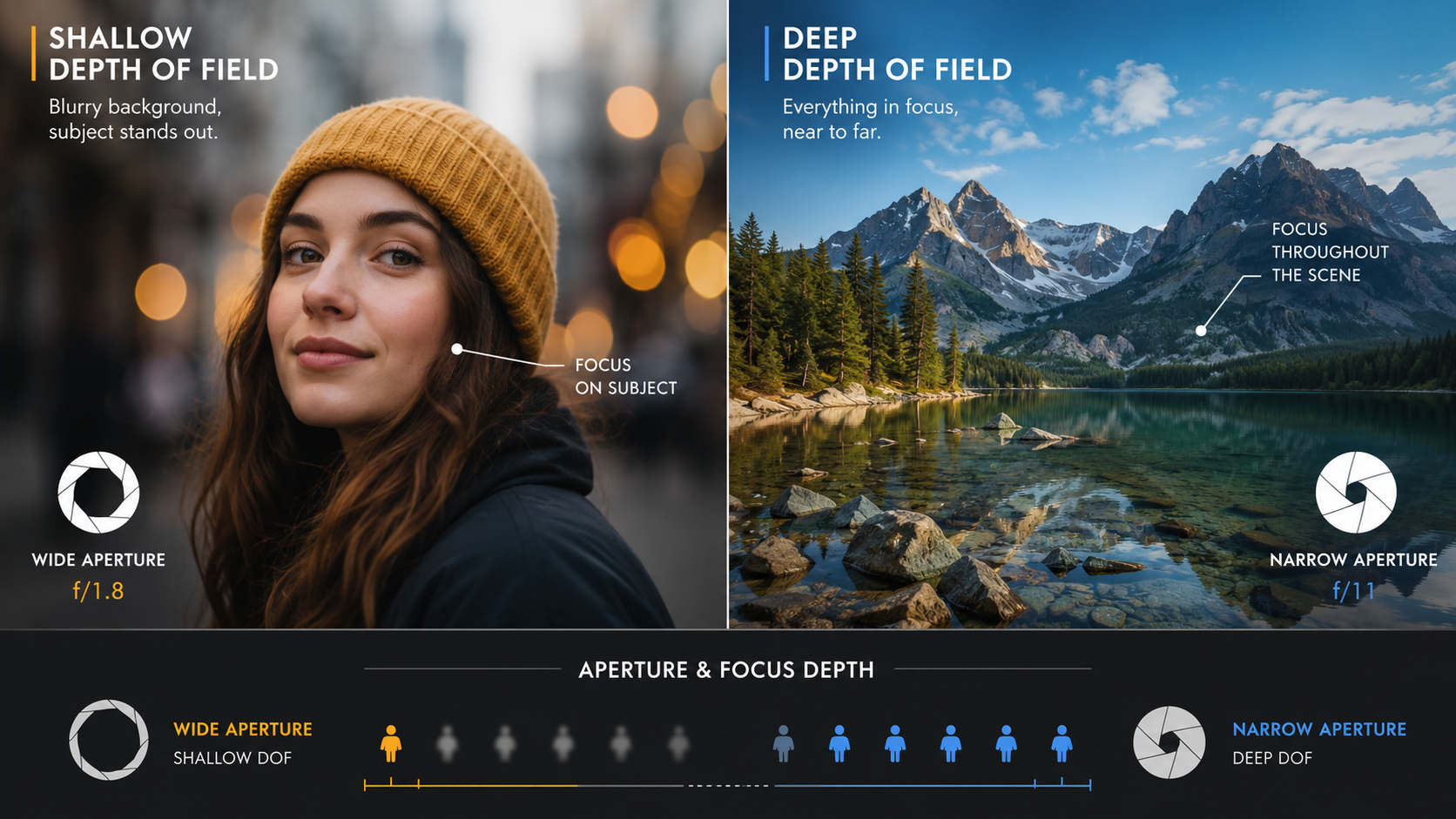
Depth of field describes how much of your photograph appears acceptably sharp in front of and behind the point you focus on.
It is one of the most useful creative controls in photography because it lets you decide whether the background should melt away into blur or whether the whole scene should appear sharp.
What is depth of field?
When you focus your camera on a subject, only one exact distance is perfectly focused.
However, an area in front of and behind that distance can still look acceptably sharp.
The size of that sharp-looking area is called depth of field.
What is shallow depth of field?
Shallow depth of field means only a relatively small part of the image appears sharp.
This is commonly used for:
- portraits;
- weddings;
- close-up photography;
- food photography;
- wildlife;
- isolating a subject from a distracting background.
The classic look is a sharp subject with a soft, blurred background.
What is deep depth of field?
Deep depth of field means a much larger part of the image appears sharp from near to far.
This is commonly useful for:
- landscapes;
- architecture;
- interiors;
- travel photography;
- group photographs;
- scenes where several distances matter.
What controls depth of field?
Four main things affect how much of the image appears sharp:
- aperture;
- focal length;
- distance between camera and subject;
- distance between subject and background.
Sensor size can also influence the depth-of-field result when you compare cameras at equivalent framing.
How aperture affects depth of field
Aperture is one of the easiest ways to control depth of field.
A wider aperture such as f/1.8, f/2 or f/2.8 generally produces a shallower depth of field.
A narrower aperture such as f/8, f/11 or f/16 generally produces a deeper depth of field.
| Aperture | Typical effect on depth of field |
|---|---|
| f/1.4 - f/2 | Very shallow |
| f/2.8 - f/4 | Shallow to moderate |
| f/5.6 - f/8 | Moderate |
| f/11 - f/16 | Deep |
These are only starting points. Focal length and distance can have a huge effect too.
Read my beginner guide to aperture for a full explanation of f-stops and exposure.
How focal length affects depth of field
Longer focal lengths can make it easier to produce strong background blur, especially when framing a subject tightly.
This is why lenses such as 85mm, 135mm and longer telephoto lenses are popular for portraits and subject isolation.
Wider focal lengths tend to give a greater apparent depth of field when used from a similar shooting position and aperture.
How distance affects depth of field
The closer you focus, the shallower depth of field becomes.
This is especially noticeable in close-up and macro photography.
At very close distances, even an aperture such as f/8 can give a surprisingly thin area of sharpness.
How background distance affects background blur
One of the easiest ways to improve background blur is to increase the distance between your subject and the background.
Imagine two portraits taken with exactly the same camera, lens and aperture.
If the subject is standing directly against a wall, the wall may remain quite recognisable.
Move the subject several metres away from the wall and that same background can become much softer.
How do I blur the background in a photo?
If you want stronger background blur, try combining these:
- use a wider aperture;
- move closer to the subject;
- move the subject farther away from the background;
- use a longer focal length;
- keep the background as distant as possible.
You do not necessarily need an extremely expensive lens.
Good subject and background positioning can make an enormous difference.
What is bokeh?
Bokeh refers to the appearance and quality of the out-of-focus areas of a photograph.
Depth of field and bokeh are related, but they are not exactly the same thing.
Depth of field describes how much appears acceptably sharp.
Bokeh describes what the blurred areas actually look like.
Does a wide aperture always create a blurry background?
No.
Aperture is only one part of the result.
If your subject is very far away and the background is close behind it, even a wide aperture may not produce dramatic blur.
Distance and focal length matter as well.
Can you get background blur at f/5.6?
Yes.
Use a longer focal length, move closer to your subject and put more distance between the subject and background.
You can create strong subject separation even when the aperture is not extremely wide.
Can you get everything sharp at f/2.8?
Sometimes.
If the subject is far away and the lens is relatively wide, a surprisingly large part of the scene can appear sharp even at f/2.8.
Again, aperture does not work in isolation.
Depth of field for portraits
Portrait photographers often use shallow depth of field to separate the person from the background.
But there is a limit.
If depth of field becomes too shallow, one eye may be sharp while the other becomes soft.
This is especially important when the person's face is angled relative to the camera.
Where should you focus in a portrait?
For a single-person portrait, focus on the eye that is nearest the camera unless there is a creative reason not to.
Modern eye autofocus can make this much easier.
My autofocus modes guide and focus area guide explain how to set the camera up for this.
Depth of field for group portraits
Group photographs usually need more depth of field than a single-person portrait.
If people are arranged in several rows, a very wide aperture can leave the front row sharp and the back row soft.
Use a smaller aperture and try to keep people at similar distances from the camera where possible.
Depth of field for landscapes
Landscape photographers often want much of the image sharp from foreground to distance.
That usually means:
- using a moderate or smaller aperture;
- carefully choosing the focus distance;
- avoiding focusing automatically on the far horizon;
- checking foreground and background sharpness.
Do you need f/22 for landscapes?
Usually not.
Very small apertures can increase depth of field, but they also introduce diffraction.
Diffraction can reduce fine detail across the image.
On many cameras, apertures around f/8 to f/11 are a useful starting point for landscapes, although the best choice depends on the composition and lens.
What is diffraction?
Diffraction is a reduction in fine image sharpness that becomes more noticeable as the aperture gets very small.
This means there is a trade-off.
Closing the aperture increases depth of field, but closing it too far can reduce fine detail.
What is the hyperfocal distance?
Hyperfocal distance is a focusing concept used mainly in landscape and architectural photography.
At a chosen focal length and aperture, focusing at the hyperfocal distance can maximise the range that appears acceptably sharp from near to far.
Beginners do not need to calculate hyperfocal distance for every photograph.
It is more important first to understand that focusing at infinity is not always the best way to maximise depth of field.
Should you focus one third into a landscape?
The old advice to "focus one third into the scene" can sometimes be a useful rough starting point, but it is not a universal rule.
Depth of field depends on aperture, focal length and focus distance, not on a fixed percentage of the composition.
Depth of field for macro photography
Macro photography produces extremely shallow depth of field because the camera is focusing very close to the subject.
Even small apertures may only give a few millimetres of apparent sharpness.
Macro photographers sometimes use focus stacking when one frame cannot provide enough depth of field.
What is focus stacking?
Focus stacking combines several photographs focused at different distances.
Software blends the sharp parts of each frame to create an image with much greater apparent depth of field.
It is commonly used for:
- macro photography;
- product photography;
- some landscape photographs.
Does sensor size affect depth of field?
Sensor size can affect the depth-of-field result when you compare cameras using equivalent framing.
A larger-sensor camera will often require a longer focal length or a closer camera position to achieve the same framing, which can lead to shallower depth of field at the same f-number.
This is why full-frame cameras are often associated with stronger background separation.
But sensor size is not a simple blur switch. Aperture, focal length, distance and framing still matter.
Does crop factor change the actual aperture?
No.
An f/2.8 aperture is still f/2.8 on the lens.
Crop factor affects field of view and can influence the depth-of-field comparison when cameras are framed equivalently, but it does not physically change the lens aperture.
Depth of field and shutter speed
Changing aperture can affect the shutter speed you need for the same exposure.
If you close from f/2.8 to f/8, much less light reaches the sensor.
You therefore need to compensate with:
- a slower shutter speed;
- a higher ISO;
- more light.
This is where depth of field connects directly with the exposure triangle .
Depth of field and ISO
ISO does not directly change depth of field.
But increasing ISO can allow you to use a smaller aperture while maintaining a usable shutter speed.
Read my ISO guide if that trade-off is still confusing.
Depth of field and autofocus
Shallow depth of field makes focusing errors much more obvious.
At f/1.4 or f/1.8, especially at close distances, the sharp zone can be extremely thin.
The camera may confirm focus correctly, but if it focuses on an eyelash, nose or background detail instead of the eye, the photograph can still look wrong.
Why is my background not blurry?
Common reasons include:
- the aperture is too small;
- you are too far from the subject;
- the background is too close to the subject;
- the focal length is very wide;
- the subject fills only a small part of the frame.
Why is too much of my photo blurry?
Common reasons include:
- the aperture is too wide;
- you are focusing very close;
- the subject has significant depth;
- people in a group are standing at different distances;
- the focus point is not placed where you intended.
A simple beginner depth-of-field workflow
- Decide how much of the image you want sharp.
- For background blur, start with a wider aperture.
- Move closer to the subject if practical.
- Increase the distance between subject and background.
- Use a longer focal length if it suits the composition.
- For more sharpness, use a smaller aperture.
- Check that your shutter speed and ISO still make sense.
- Zoom into the image and check the important areas are actually sharp.
Common beginner depth-of-field mistakes
Thinking aperture is the only control
Distance and focal length are just as important.
Using f/1.4 for every portrait
Extremely shallow depth of field can leave important facial features soft.
Using f/22 whenever you want everything sharp
Very small apertures can introduce diffraction and may force an unnecessarily slow shutter speed.
Putting the subject against the background
Increasing background distance can often improve blur more than simply opening the aperture another stop.
Focusing on the horizon for every landscape
That can waste a large amount of depth of field behind the focus point while leaving the foreground soft.
Depth of field - key points
- Depth of field is the range that appears acceptably sharp.
- Wide apertures generally reduce depth of field.
- Small apertures generally increase depth of field.
- Closer focusing reduces depth of field.
- Longer focal lengths can help create stronger separation.
- More subject-to-background distance increases background blur.
- Very small apertures can introduce diffraction.
- Shallow depth of field makes focusing accuracy more critical.
Want to control what is sharp instead of leaving it to the camera?
My beginner photography courses cover depth of field, aperture, focusing, shutter speed, ISO, exposure and practical camera control step by step. You can learn online or through practical one-to-one tuition around Portsmouth.
Explore beginner photography coursesContinue learning photography

Andy Hornby
Photographer, educator and workshop leader with more than twenty-five years of practical photography experience.
Learn with Andy